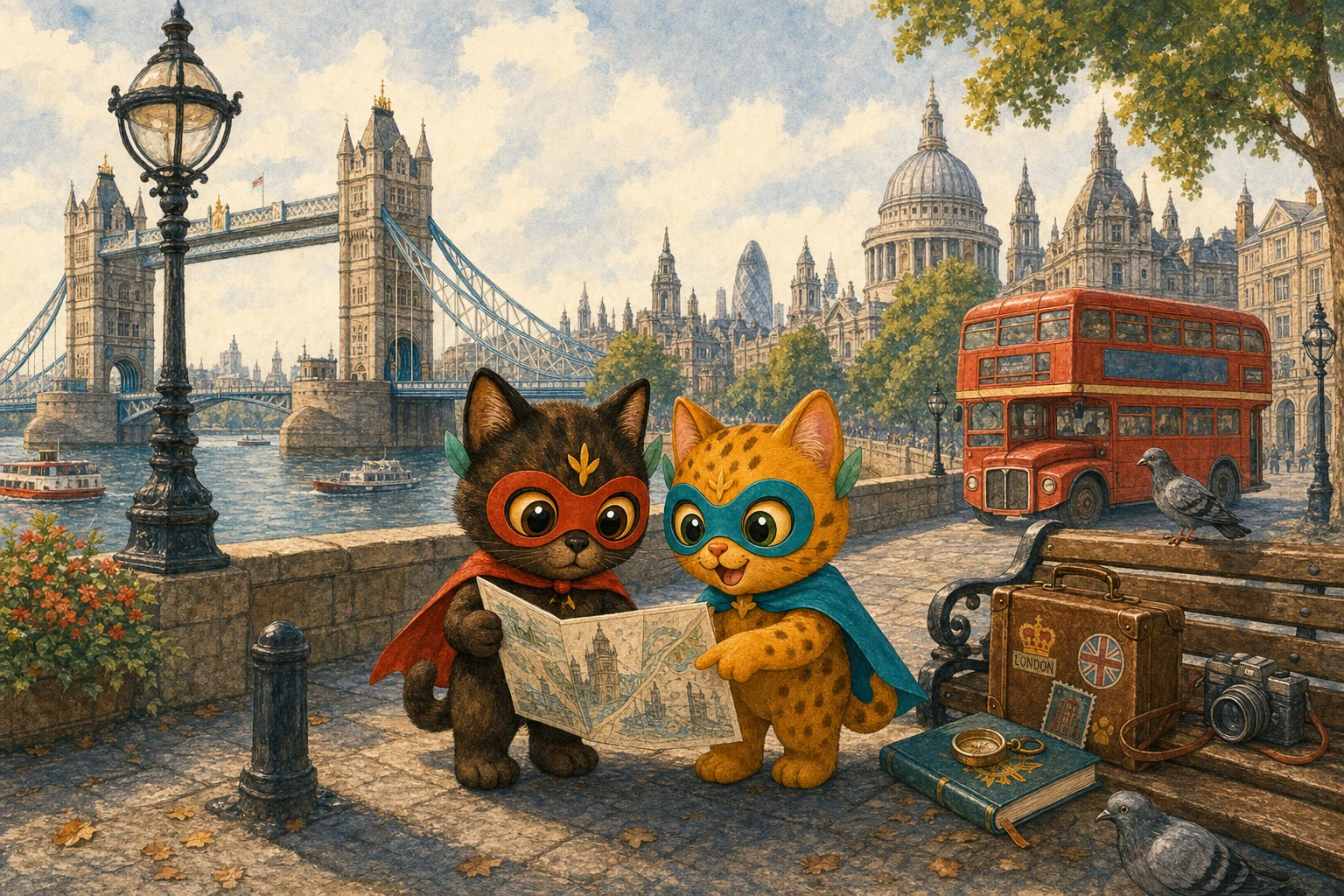
LONDON WITH KIDS
Things to Do in London with Kids Ages 8–11
Eight London experiences with royal clues, transport missions, river views, and practical family itineraries.
Published · 14 minute read
What are the best things to do in London with kids ages 8 to 11?
London becomes easier for children when its layers are treated as evidence. A Roman wall, a medieval fortress, a Tube diagram, a royal park, and a modern skyline can all belong to the same day.
- 1. Tower of London: Treat the Tower as a working fortress
- 2. Tower Bridge: Find out how Tower Bridge opens
- 3. Westminster: Read Parliament through symbols and sound
- 4. St James’s Park: Follow a royal route through the parks
- 5. London Transport Museum: Decode why the Tube map works
- 6. Natural History Museum: Choose one scientific argument
- 7. Greenwich: Stand on the line that organizes world time
- 8. South Bank: Use the Thames as a timeline
Keep journeys geographically tight. The city rewards families who use the river, buses, and walking routes as part of the experience instead of treating every ride as dead time.
London family itineraries for one to four days
London landmarks
Royal and riverside London first.
Day 1: Royal London on foot
Connect Westminster, parkland, and palace approaches. Stops: Westminster and St James’s Park. Mostly outdoors and easy to shorten if weather changes.
Day 2: Fortress and bridge
Keep the day around the eastern riverfront. Stops: Tower of London and Tower Bridge. Two ticketed landmarks are enough. Use the riverside for breaks.
Day 3: London from the Thames
Take the boat east and return through the South Bank. Stops: Greenwich and South Bank. Greenwich can fill the day by itself. Drop South Bank if the family is tired.
Day 4: Maps and natural history
Let each museum answer one clear question. Stops: London Transport Museum and Natural History Museum. The museums are not adjacent. Use one direct Tube journey between them.
For curious kids
Museums, maps, and engineering lead the trip.
Day 1: Maps and natural history
Let each museum answer one clear question. Stops: London Transport Museum and Natural History Museum. The museums are not adjacent. Use one direct Tube journey between them.
Day 2: Fortress and bridge
Keep the day around the eastern riverfront. Stops: Tower of London and Tower Bridge. Two ticketed landmarks are enough. Use the riverside for breaks.
Day 3: London from the Thames
Take the boat east and return through the South Bank. Stops: Greenwich and South Bank. Greenwich can fill the day by itself. Drop South Bank if the family is tired.
Day 4: Royal London on foot
Connect Westminster, parkland, and palace approaches. Stops: Westminster and St James’s Park. Mostly outdoors and easy to shorten if weather changes.
Stop 1: Tower of London
Treat the Tower as a working fortress
Begin outside and ask what the walls were designed to control. Inside, follow one thread: royal power, imprisonment, armor, ravens, or the Crown Jewels.
The site is large and dense. Choosing a single story gives children something to connect from one courtyard to the next.
Bobo & Lumen mission: Find three features that make the Tower feel defensive and one that makes it feel like a palace.
Good to know: Book ahead, arrive early, and expect uneven surfaces. Decide before entry whether the Crown Jewels queue is central to your visit.
Stop 2: Tower Bridge
Find out how Tower Bridge opens
From the riverbank, children can separate the stone towers from the moving bascules and upper walkways. The engineering exhibition makes the bridge easier to read as a machine.
If a bridge lift is scheduled, watching from outside can be as memorable as going in. Check the official lift times before planning the day.
Bobo & Lumen mission: Predict which parts move and where the counterweights must be hidden.
Good to know: Combine this with the Tower of London only if your children still have attention left. Both deserve more than a rushed pass.
Stop 3: Westminster
Read Parliament through symbols and sound
Stand where Big Ben, Parliament, Westminster Abbey, and the river can be compared. Ask which building looks oldest, which looks most powerful, and what evidence supports each answer.
The area is crowded, so give the child one observation job rather than a long history lecture. The clock strike provides a natural end point.
Bobo & Lumen mission: Choose the building detail that communicates authority most clearly.
Good to know: Use Parliament Square as a fixed meeting point and avoid weekday commuter peaks when pavements are busiest.
Stop 4: St James’s Park
Follow a royal route through the parks
Walk from Parliament toward Buckingham Palace through St James’s Park. The route introduces royal ceremony without requiring a palace ticket.
Let children track sightlines, gates, guards, memorials, and changing park design. The lake and wildlife provide a useful reset after Westminster.
Bobo & Lumen mission: Design a new royal procession route and explain which landmarks it should pass.
Good to know: Changing-the-Guard schedules vary and crowds gather early. Treat it as a bonus unless you have checked the official timetable.
Stop 5: London Transport Museum
Decode why the Tube map works
Compare a geographic map with the famous diagram. Children quickly notice that the Tube version bends distance and direction to make connections clearer.
Historic buses, trains, signs, and posters show how London learned to move millions of people while keeping the system understandable.
Bobo & Lumen mission: Find one way the Tube map is inaccurate and explain why that inaccuracy is useful.
Good to know: This pairs naturally with Covent Garden. Check family-program schedules and leave time to test the interactive exhibits.
Stop 6: Natural History Museum
Choose one scientific argument
The museum is too large for a complete visit. Pick a question: how species change, why earthquakes happen, what makes a dinosaur reconstruction credible, or how minerals form.
Ask children to collect three pieces of evidence before deciding what they think. The building itself can be a final object of investigation.
Bobo & Lumen mission: Find one display where the evidence matters more than the size of the object.
Good to know: Reserve where requested and arrive with a chosen gallery. The Science Museum and Hyde Park are nearby, but adding both can make the day too long.
Stop 7: Greenwich
Stand on the line that organizes world time
Greenwich connects navigation, astronomy, longitude, maps, ships, and the river in one district. Children can put one foot on either side of the Prime Meridian and then ask why the line is here.
Arriving by riverboat reveals how far Greenwich sits from Westminster and why the Thames shaped London.
Bobo & Lumen mission: Invent a different prime meridian and argue why the world should use it.
Good to know: Give Greenwich most of a day. The hill is steep and the museums, Cutty Sark, market, and park cannot all be rushed.
Stop 8: South Bank
Use the Thames as a timeline
Walk a short stretch between bridges and let children arrange what they see by age: cathedral, market, theatre, power station, office tower, and modern footbridge.
The river keeps the route legible and offers frequent places to stop. It is an effective flexible day when weather and energy are uncertain.
Bobo & Lumen mission: Choose five visible structures and place them in order from oldest to newest.
Good to know: Do not attempt the whole South Bank. Pick a start and finish bridge, then add one indoor stop such as Tate Modern.
Practical planning tips for families
- Group each day by one part of London.
- Use buses or riverboats when the journey itself adds a view.
- Reserve one major indoor attraction, then keep the second half flexible.
- Carry a contact card for each child in crowded areas.
- Check official ceremonial schedules rather than building a day around assumptions.
Check current details before you go
Opening hours, reservation rules, accessibility, and temporary closures can change. Use these primary sources when planning:
Explore London with the illustrated kids' guide
The guide gives children enough context to understand what they are seeing, then hands them something specific to investigate. It works before the trip, on the street, and again when the family gets home.
See inside the London travel guide for kids