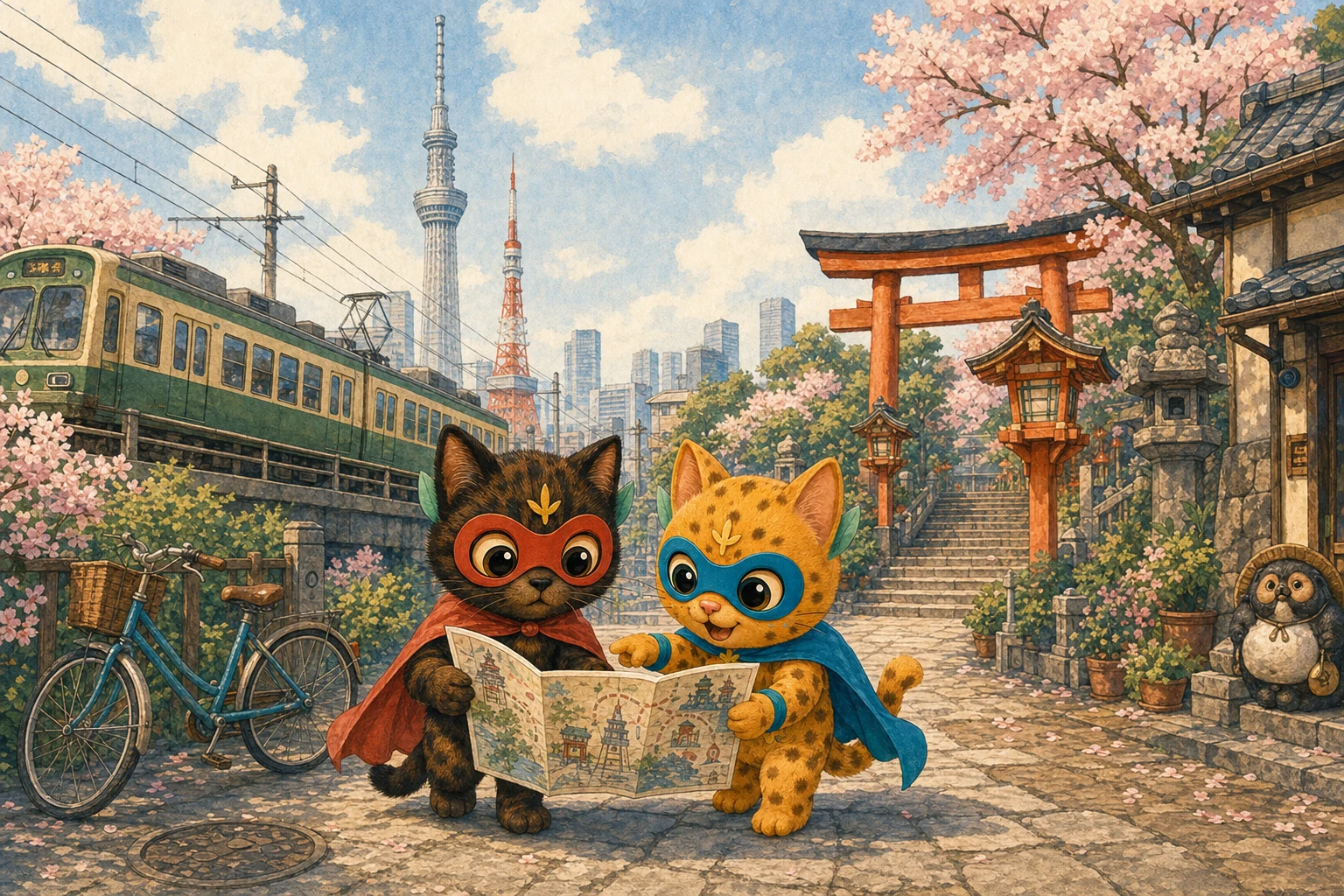
TOKYO WITH KIDS
Things to Do in Tokyo with Kids Ages 8–11
Eight Tokyo experiences built around trains, temples, city design, science, gardens, and careful observation.
Published · 14 minute read
What are the best things to do in Tokyo with kids ages 8 to 11?
Tokyo is easier to understand when children learn its systems. Station colors, platform markings, shrine approaches, vending machines, tiny gardens, and neighborhood rules all reveal how a huge city stays workable.
- 1. Sensō-ji and Asakusa: Read the approach to Sensō-ji in stages
- 2. Ueno Park: Build one Ueno day around a single interest
- 3. Shibuya Crossing: Study how a crossing handles a crowd
- 4. Meiji Jingu: Notice how a forest changes the city
- 5. Tokyo Station: Decode one of the world’s busiest stations
- 6. Miraikan: Test how scientists imagine the future
- 7. Hama-rikyū Gardens: Find the old landscape inside modern Tokyo
- 8. Tokyo Metropolitan Government Building: Understand Tokyo from above
Avoid crossing the metropolitan area repeatedly. Choose one or two adjacent districts per day, travel outside peak commuting periods, and keep an indoor option ready for heat or rain.
Tokyo family itineraries for one to four days
First Tokyo trip
Historic east, energetic west, then the bay.
Day 1: Temple and museum Tokyo
Keep the day around Asakusa and Ueno. Stops: Sensō-ji and Asakusa and Ueno Park. Choose only one major Ueno institution.
Day 2: Crowds, forest, and a view
Compare three forms of western Tokyo. Stops: Shibuya Crossing and Meiji Jingu and Tokyo Metropolitan Government Building. Start at the shrine or viewpoint and save Shibuya for later.
Day 3: Tokyo’s future by the bay
Give Odaiba time, then recover in a garden. Stops: Miraikan and Hama-rikyū Gardens. Use the water connection if the schedule and weather work.
Day 4: A city that explains itself
Let station design and signage become the main subject. Stops: Tokyo Station. Add an unplanned department-store food hall rather than another distant attraction.
Lower sensory load
Gardens and structured museums before the busiest districts.
Day 1: Tokyo’s future by the bay
Give Odaiba time, then recover in a garden. Stops: Miraikan and Hama-rikyū Gardens. Use the water connection if the schedule and weather work.
Day 2: Temple and museum Tokyo
Keep the day around Asakusa and Ueno. Stops: Sensō-ji and Asakusa and Ueno Park. Choose only one major Ueno institution.
Day 3: A city that explains itself
Let station design and signage become the main subject. Stops: Tokyo Station. Add an unplanned department-store food hall rather than another distant attraction.
Day 4: Crowds, forest, and a view
Compare three forms of western Tokyo. Stops: Shibuya Crossing and Meiji Jingu and Tokyo Metropolitan Government Building. Start at the shrine or viewpoint and save Shibuya for later.
Stop 1: Sensō-ji and Asakusa
Read the approach to Sensō-ji in stages
Begin at Kaminarimon and notice how gates, lanterns, shopping street, incense, and temple buildings prepare visitors step by step.
Ask children to distinguish religious spaces from commercial ones and observe the small behaviors people use to show respect.
Bobo & Lumen mission: Find three changes that signal you are moving from city street toward sacred space.
Good to know: Visit early for a calmer approach. Explain basic temple etiquette before arrival and keep food away from worship areas.
Stop 2: Ueno Park
Build one Ueno day around a single interest
Ueno combines museums, temples, a pond, paths, and a zoo. Let each child choose one main institution, then use the park itself for the rest of the day.
The Tokyo National Museum works well for a focused object hunt, while the National Museum of Nature and Science suits children who want experiments, fossils, or engineering.
Bobo & Lumen mission: Choose one object that could represent Japan to someone who has never visited.
Good to know: Many museums close one weekday and require separate tickets. Check calendars before assigning the family’s choice.
Stop 3: Shibuya Crossing
Study how a crossing handles a crowd
Watch one signal cycle from a safe viewpoint before joining it. Count directions, notice lane markings, and see how quickly the space changes from vehicles to people and back.
The crossing is a compact lesson in timing and shared rules. Leave once the question is answered rather than repeating it for photographs.
Bobo & Lumen mission: Design one change that would make the crossing safer without moving fewer people.
Good to know: Keep the family together and choose a meeting point before entering the crowd. Avoid commuter rush periods.
Stop 4: Meiji Jingu
Notice how a forest changes the city
Walk from the busy station toward the shrine and listen for the point where traffic begins to fade. The broad path, torii gates, trees, barrels, and gravel create a deliberate transition.
Compare this experience with Sensō-ji. Both are sacred places, but the approach, sound, density, and surrounding landscape are very different.
Bobo & Lumen mission: Find the exact place where the city starts to feel quieter and record the clues.
Good to know: Stay on marked paths, follow shrine etiquette, and allow more walking time than the map distance suggests.
Stop 5: Tokyo Station
Decode one of the world’s busiest stations
Use colors, platform numbers, arrows, floor markings, and destination boards to navigate one simple journey. Children can lead only after explaining the route back to an adult.
Outside, compare the restored Marunouchi façade with the modern towers around it. One place holds several eras of Tokyo.
Bobo & Lumen mission: Collect five different systems the station uses to prevent people from getting lost.
Good to know: Do this outside peak hours. Choose a simple route and never let the navigation game separate the group.
Stop 6: Miraikan
Test how scientists imagine the future
At the National Museum of Emerging Science and Innovation, choose one question about robots, space, Earth systems, medicine, or communication.
Ask which exhibits show established knowledge and which explore possibilities. Children often enjoy noticing where science ends and design choices begin.
Bobo & Lumen mission: Find one future idea that solves a real problem and one new problem it might create.
Good to know: Check demonstration schedules and temporary exhibitions. Odaiba is best treated as its own half-day or full day.
Stop 7: Hama-rikyū Gardens
Find the old landscape inside modern Tokyo
Skyscrapers frame ponds, bridges, pines, and tidal water. Children can compare foreground and background and ask how each changes the other.
The garden is a useful low-noise day after Shibuya or a major museum. Look for evidence that the water level connects to Tokyo Bay.
Bobo & Lumen mission: Frame one view where old and new Tokyo depend on each other.
Good to know: Paths are exposed in summer. Check garden hours and consider arriving or leaving by water bus.
Stop 8: Tokyo Metropolitan Government Building
Understand Tokyo from above
A high view makes the city’s scale visible. Find rail corridors, parkland, clusters of towers, mountains on a clear day, and neighborhoods that looked separate from street level.
Use the view at the beginning or end of the trip. Children can test whether their mental map has become more accurate.
Bobo & Lumen mission: Point to three places you visited and explain the route between them without using a phone.
Good to know: Observation-deck access and opening hours can change. Expect security and check visibility before making a special journey.
Practical planning tips for families
- Avoid peak commuter periods with children and luggage.
- Choose adjacent districts rather than famous places scattered across the map.
- Keep a paper copy of the hotel address.
- Use department stores for reliable food, toilets, and weather breaks.
- Explain shrine and temple etiquette before entering.
Check current details before you go
Opening hours, reservation rules, accessibility, and temporary closures can change. Use these primary sources when planning:
Explore Tokyo with the illustrated kids' guide
The guide gives children enough context to understand what they are seeing, then hands them something specific to investigate. It works before the trip, on the street, and again when the family gets home.
See inside the Tokyo travel guide for kids