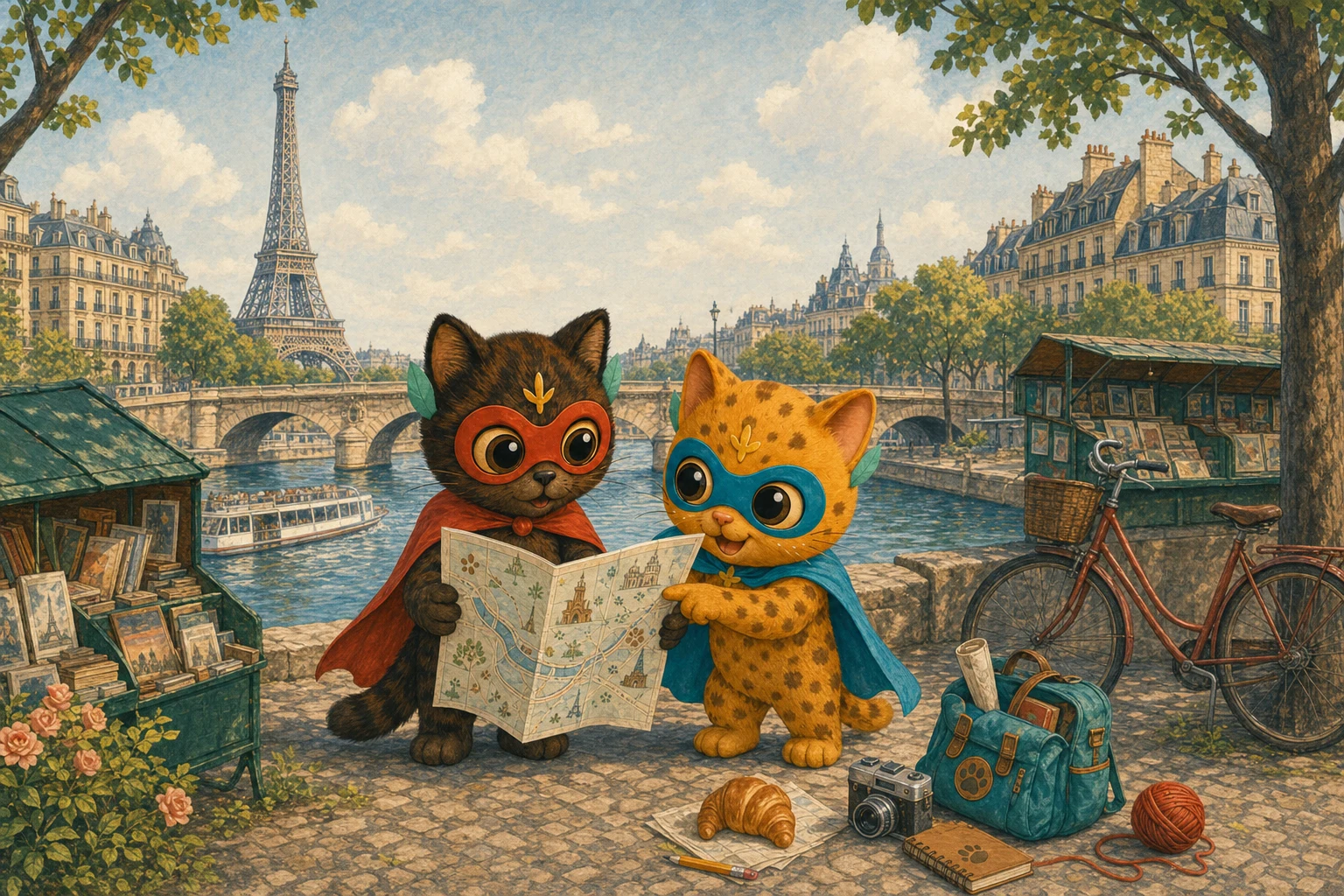
PARIS WITH KIDS
Things to Do in Paris with Kids Ages 8–11
Eight Paris experiences that turn art, streets, gardens, engineering, and food into child-led discoveries.
Published · 14 minute read
What are the best things to do in Paris with kids ages 8 to 11?
Paris works well for this age when children are invited to compare rather than simply admire. One bridge can be tested against another, one painting can be studied closely, and one pastry can become a lesson in texture and language.
- 1. Eiffel Tower: Read the Eiffel Tower as a giant structure
- 2. Louvre Museum: Visit the Louvre with a three-object rule
- 3. Luxembourg Gardens: Use the Luxembourg Gardens as a design lab
- 4. Île de la Cité: Trace how Paris began on the river islands
- 5. Montmartre: Hunt for the old village inside Montmartre
- 6. Cité des Sciences: Give a rainy day to experiments
- 7. Musée d’Orsay: Compare the painting with the Paris outside
- 8. Canal Saint-Martin: Watch water move through the city
Build days around neighborhoods and river crossings. Long diagonal journeys across the city consume the energy children need for the places themselves.
Paris family itineraries for one to four days
First Paris trip
Begin with the river, tower, and central landmarks.
Day 1: Tower and river origins
Use two ends of the Seine story. Stops: Eiffel Tower and Île de la Cité. Travel between them by river or a direct route. Do not add another tower.
Day 2: Three artworks, then a garden
Keep the Louvre focused and recover outdoors. Stops: Louvre Museum and Luxembourg Gardens. Three chosen works are enough for a successful museum visit.
Day 3: Village hill and working canal
Look for two forms of Paris beyond the monuments. Stops: Montmartre and Canal Saint-Martin. Start early on Montmartre before the busiest period.
Day 4: Art and experiments
Let children compare looking closely with testing directly. Stops: Musée d’Orsay and Cité des Sciences. These museums are far apart. Choose one if attention or travel time is limited.
Creative Paris
Art, experiments, and neighborhood observation first.
Day 1: Three artworks, then a garden
Keep the Louvre focused and recover outdoors. Stops: Louvre Museum and Luxembourg Gardens. Three chosen works are enough for a successful museum visit.
Day 2: Art and experiments
Let children compare looking closely with testing directly. Stops: Musée d’Orsay and Cité des Sciences. These museums are far apart. Choose one if attention or travel time is limited.
Day 3: Village hill and working canal
Look for two forms of Paris beyond the monuments. Stops: Montmartre and Canal Saint-Martin. Start early on Montmartre before the busiest period.
Day 4: Tower and river origins
Use two ends of the Seine story. Stops: Eiffel Tower and Île de la Cité. Travel between them by river or a direct route. Do not add another tower.
Stop 1: Eiffel Tower
Read the Eiffel Tower as a giant structure
Before going up, study the tower from the Champ de Mars or Trocadéro. Ask where the weight travels, why the legs curve, and how wind might change the design.
From higher levels, children can find the Seine, bridges, parks, and monuments they will visit later. The view becomes an orientation exercise rather than only a photograph.
Bobo & Lumen mission: Sketch the simplest structure that could still hold up the top platform.
Good to know: Reserve official tickets early, verify the selected access level, and expect security lines. Wind and exposed sun can change the experience.
Stop 2: Louvre Museum
Visit the Louvre with a three-object rule
Choose three works before entering: one famous object, one object connected to the child’s interests, and one surprise selected on the spot.
The Louvre itself tells a story from fortress to palace to museum. Include the medieval foundations or one architectural clue so the visit is not only about paintings.
Bobo & Lumen mission: For each chosen object, find one detail that would disappear in a small reproduction.
Good to know: Reserve a timed ticket, allow extra time from the Metro to the galleries, and keep the museum visit short enough to enjoy the Tuileries afterward.
Stop 3: Luxembourg Gardens
Use the Luxembourg Gardens as a design lab
Compare straight allées, clipped trees, statues, lawns, fountains, and less formal corners. Ask what behavior each space seems designed to encourage.
Model sailboats, playgrounds, chess tables, and chairs make the garden useful between more concentrated visits. Children can decide where the family pauses.
Bobo & Lumen mission: Design a new garden corner for children and explain where it belongs.
Good to know: Some activities have separate hours or fees. Garden closing times change with the season.
Stop 4: Île de la Cité
Trace how Paris began on the river islands
Walk a compact loop around Île de la Cité and the nearby riverbanks. The island makes it easier to understand bridges, defense, trade, religion, and flood risk.
Use Notre-Dame’s exterior, the archaeological crypt, bookstalls, and views toward the neighboring island as evidence of different periods.
Bobo & Lumen mission: Choose the best location for the first settlement and defend it using the river and bridges.
Good to know: Access rules around Notre-Dame and nearby sites can change. Keep the route outdoors unless you have confirmed current entry arrangements.
Stop 5: Montmartre
Hunt for the old village inside Montmartre
Move away from the busiest square and look for steep lanes, small houses, vineyard traces, staircases, windmill references, and changing views over Paris.
The hill lets children compare a former village pattern with the denser boulevards below. Give them responsibility for choosing one descent route.
Bobo & Lumen mission: Find three clues that this neighborhood did not begin as central Paris.
Good to know: Expect stairs and crowded viewpoints. Use the funicular for one direction if needed and avoid restaurants immediately beside the busiest sights.
Stop 6: Cité des Sciences
Give a rainy day to experiments
The science museum works best when children choose a theme rather than trying every floor. Space, mathematics, sound, energy, and the human body can each anchor a visit.
Pair the museum with Parc de la Villette so concentrated indoor time has an outdoor release nearby.
Bobo & Lumen mission: Choose one exhibit where changing a single variable changes the result.
Good to know: Some family spaces require separate timed reservations and have age bands. Check language availability and session times.
Stop 7: Musée d’Orsay
Compare the painting with the Paris outside
Choose landscapes, stations, bridges, crowds, or café scenes, then compare the painted city with what children have already seen.
The former railway station is part of the experience. Its clock, long central hall, and river location can be read alongside the collection.
Bobo & Lumen mission: Find one artwork that changes how you notice modern Paris outside the museum.
Good to know: Pick one floor or theme. The museum is easier to manage than the Louvre, but it still rewards a short planned route.
Stop 8: Canal Saint-Martin
Watch water move through the city
At the canal, children can watch locks raise and lower boats, notice footbridges rotate or lift, and compare the calm water with the Seine.
This is also a good place for an unstructured food stop. Buy one unfamiliar bakery item, learn its French name, and describe its layers or texture.
Bobo & Lumen mission: Explain how the lock moves a boat uphill without lifting the boat out of the water.
Good to know: Stay behind barriers around working locks and choose a daylight stretch with open cafés and clear paths.
Practical planning tips for families
- Keep each day on one side or one stretch of the Seine.
- Reserve towers and major museums, but leave gardens flexible.
- Use one museum question instead of a masterpiece checklist.
- Carry water because fountains and shade are uneven across routes.
- Let children order one simple item in French.
Check current details before you go
Opening hours, reservation rules, accessibility, and temporary closures can change. Use these primary sources when planning:
Explore Paris with the illustrated kids' guide
The guide gives children enough context to understand what they are seeing, then hands them something specific to investigate. It works before the trip, on the street, and again when the family gets home.
See inside the Paris travel guide for kids