LOS ANGELES WITH KIDS
Things to Do in Los Angeles with Kids Ages 8–11
Eight Los Angeles experiences that make sense of space, cinema, fossils, neighborhoods, museums, and the Pacific.
Published · 14 minute read
What are the best things to do in Los Angeles with kids ages 8 to 11?
Los Angeles is not one walkable center. It is a collection of districts separated by real distance, traffic, hills, and different histories. A successful family plan accepts that geography.
- 1. Griffith Observatory: Use the observatory to orient the whole city
- 2. Getty Center: Investigate how art, architecture, and gardens frame a view
- 3. California Science Center: Follow one system through the Science Center
- 4. Natural History Museum: Connect dinosaurs to living Los Angeles
- 5. La Brea Tar Pits: Find the Ice Age under the modern street
- 6. Santa Monica Pier: Use the pier to study the edge of the continent
- 7. Little Tokyo: Read migration history through one neighborhood
- 8. Arts District: Compare old industrial Los Angeles with its new uses
Choose one zone per day and let the landscape explain the city: mountains above the grid, fossils under the asphalt, film sets inside warehouses, rail lines returning to old corridors, and the Pacific marking the western edge.
Los Angeles family itineraries for one to four days
First Los Angeles trip
Views, science, fossils, and ocean.
Day 1: City from above
Start with the basin from Griffith and end with the Getty’s framed views. Stops: Griffith Observatory and Getty Center. These sites are far apart. Attempt both only with a clear transport plan.
Day 2: Science in Exposition Park
Choose one main museum and one short companion visit. Stops: California Science Center and Natural History Museum. Do not give both museums equal time.
Day 3: From Ice Age asphalt to the Pacific
Compare evidence under the city with the active coastline. Stops: La Brea Tar Pits and Santa Monica Pier. Travel west before afternoon traffic builds.
Day 4: Two downtown neighborhood stories
Connect community memory and industrial change. Stops: Little Tokyo and Arts District. Mostly walking, with plenty of flexible food stops.
Less driving
Clustered districts and museums before cross-city days.
Day 1: Two downtown neighborhood stories
Connect community memory and industrial change. Stops: Little Tokyo and Arts District. Mostly walking, with plenty of flexible food stops.
Day 2: Science in Exposition Park
Choose one main museum and one short companion visit. Stops: California Science Center and Natural History Museum. Do not give both museums equal time.
Day 3: From Ice Age asphalt to the Pacific
Compare evidence under the city with the active coastline. Stops: La Brea Tar Pits and Santa Monica Pier. Travel west before afternoon traffic builds.
Day 4: City from above
Start with the basin from Griffith and end with the Getty’s framed views. Stops: Griffith Observatory and Getty Center. These sites are far apart. Attempt both only with a clear transport plan.
Stop 1: Griffith Observatory
Use the observatory to orient the whole city
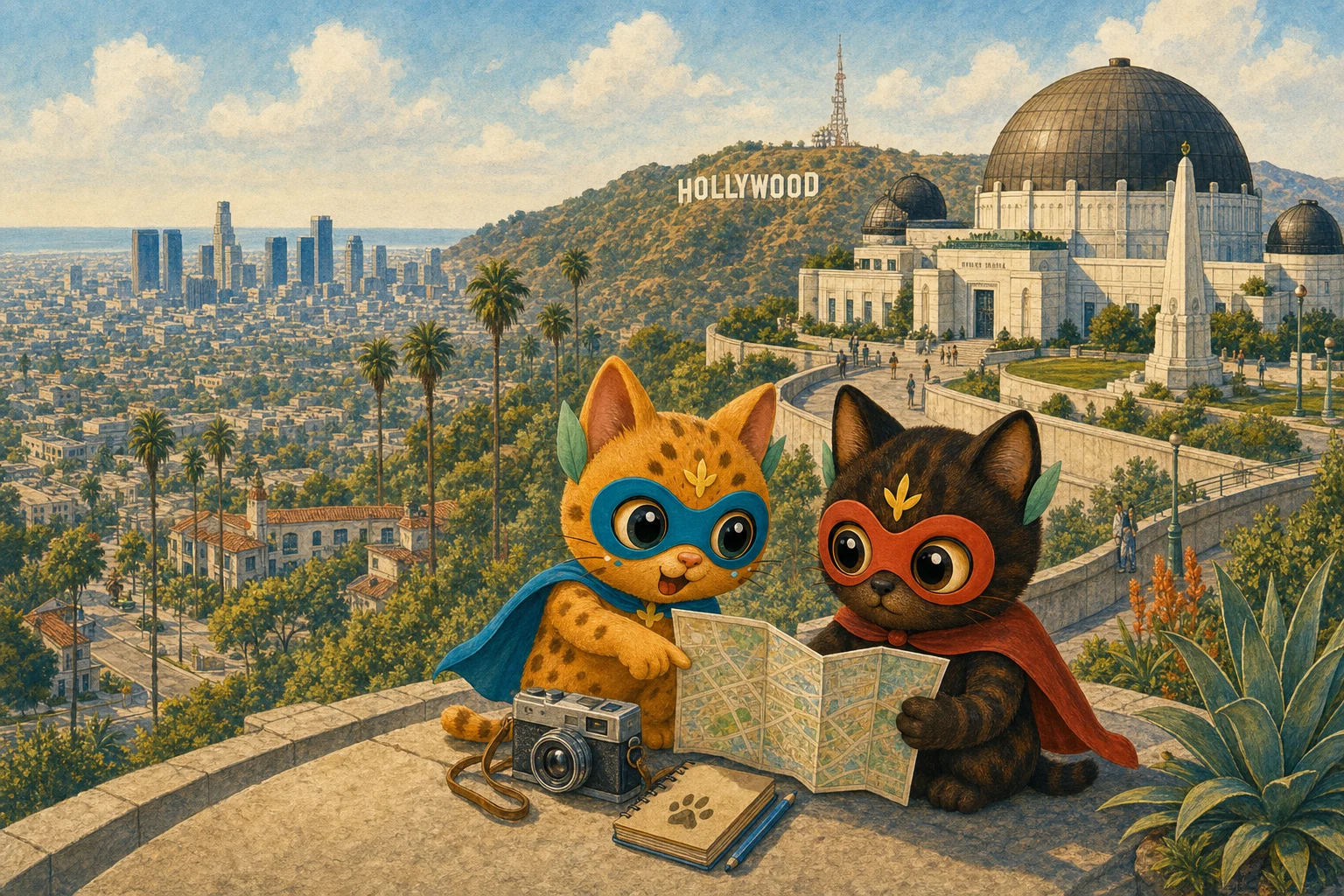
From Griffith, children can find the street grid, downtown, basin, mountains, Hollywood Sign, and ocean haze. The view explains why nearby places can still take a long time to reach.
Inside, connect one astronomy exhibit to what is visible outside: sunlight, rotation, telescopes, or the changing sky.
Bobo & Lumen mission: Point to the city’s natural boundaries and explain how they affect movement.
Good to know: Check opening days, planetarium schedules, heat, and transport. Parking is limited, so the public shuttle may be the simplest choice.
Stop 2: Getty Center
Investigate how art, architecture, and gardens frame a view
The Getty is not only a set of galleries. Children can compare stone, water, curves, grids, gardens, and sightlines across the campus.
Choose a few artworks, then use the outdoor spaces to see how the building controls attention just as a frame does.
Bobo & Lumen mission: Find one place where the architecture tells you exactly where to look.
Good to know: Admission is free but timed entry and paid parking may apply. Reserve through the official site and allow time for the tram.
Stop 3: California Science Center
Follow one system through the Science Center
Choose ecosystems, flight, engineering, fire, or space and test several exhibits connected to the same question.
Exposition Park makes it possible to combine the museum with gardens or another nearby institution without driving across Los Angeles.
Bobo & Lumen mission: Find one machine and explain its input, process, and output.
Good to know: General admission and special exhibitions may work differently. Check current reservations, galleries, and construction notices.
Stop 4: Natural History Museum
Connect dinosaurs to living Los Angeles
Use fossils as one part of a longer story about changing environments. Then compare ancient evidence with the Nature Gardens and urban wildlife outside.
Children can ask how scientists reconstruct behavior when bones preserve shape but not sound, color, or movement.
Bobo & Lumen mission: Find one claim about an extinct animal and identify the evidence supporting it.
Good to know: This sits beside the Science Center. Choose one as the main visit and use the other only if attention remains.
Stop 5: La Brea Tar Pits
Find the Ice Age under the modern street
The tar pits make deep time visible in the middle of the city. Look at active excavation areas, bubbles, fossils, and the contrast with traffic and office buildings nearby.
Ask why some animals were trapped and why their remains survived here.
Bobo & Lumen mission: Build a chain of events explaining how one bone moved from a living animal into the museum collection.
Good to know: Outdoor pits can be explored without a long museum visit. Check excavation activity, museum tickets, and heat.
Stop 6: Santa Monica Pier
Use the pier to study the edge of the continent
Look back toward the city, along the coast, and out across the Pacific. Compare natural forces with the engineered pier, rides, breakwaters, and lifeguard systems.
The amusement area does not need to dominate. Give the family one chosen ride or game, then return to beach observation.
Bobo & Lumen mission: Find three structures designed to handle waves, wind, sand, or sun.
Good to know: Check water conditions and keep a fixed meeting point. Parking and traffic can consume time, so consider rail access.
Stop 7: Little Tokyo
Read migration history through one neighborhood
Museums, memorials, markets, restaurants, religious sites, and shop signs reveal how Japanese American history is remembered and lived.
The Japanese American National Museum can provide context before a short food and observation walk.
Bobo & Lumen mission: Find one object or place that connects a family story to a larger American story.
Good to know: Check museum days and community events. Ask before photographing inside small businesses or places of worship.
Stop 8: Arts District
Compare old industrial Los Angeles with its new uses
Warehouses, rail traces, loading doors, murals, apartments, cafés, and studios show how a district changes without erasing every earlier clue.
Children can identify which structures were adapted and which were newly built to imitate an industrial look.
Bobo & Lumen mission: Choose one building and tell its story using only visible evidence.
Good to know: Use a compact daylight route and research the exact start and finish. The district changes quickly and blocks vary.
Practical planning tips for families
- Choose one geographic zone per day.
- Estimate travel time at the hour you will actually move.
- Use rail when it connects directly and avoid moving a car for short stops.
- Keep one outdoor view or park beside every museum plan.
- Treat free museums as reservations when timed entry is required.
Check current details before you go
Opening hours, reservation rules, accessibility, and temporary closures can change. Use these primary sources when planning:
Explore Los Angeles with the illustrated kids' guide
The guide gives children enough context to understand what they are seeing, then hands them something specific to investigate. It works before the trip, on the street, and again when the family gets home.
See inside the Los Angeles travel guide for kids