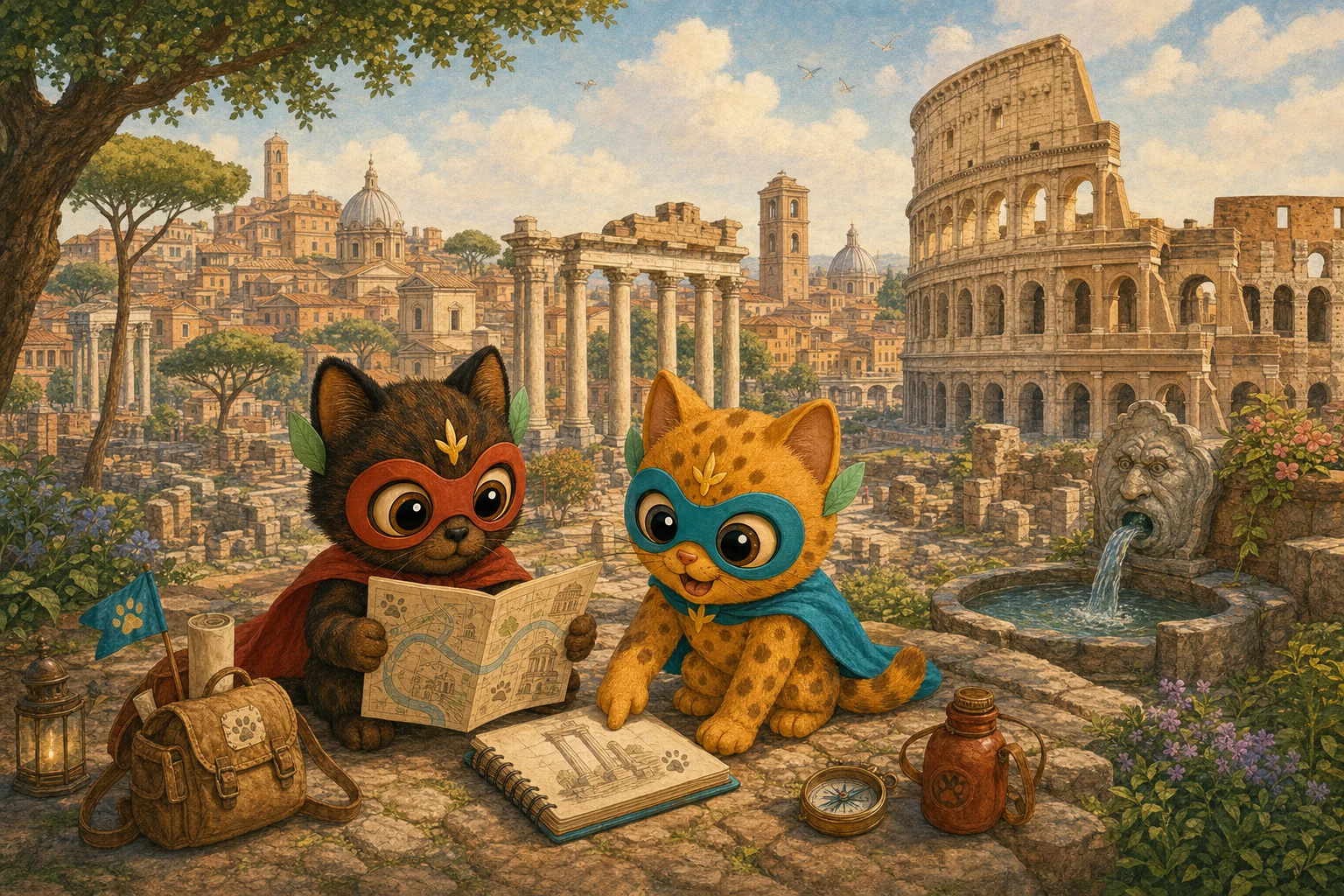
ROME WITH KIDS
Things to Do in Rome with Kids Ages 8–11
Eight Rome experiences that use ruins, fountains, streets, parks, maps, and engineering to make ancient history tangible.
Published · 14 minute read
What are the best things to do in Rome with kids ages 8 to 11?
Rome makes history visible, but too many ruins without a question become a blur. Give each site one problem to solve: how crowds moved, where water came from, why a temple survived, or how fragments become a map.
- 1. Colosseum: Reconstruct how the Colosseum moved a crowd
- 2. Roman Forum: Turn the Forum ruins back into a city center
- 3. Pantheon: Solve the Pantheon dome
- 4. Trevi Fountain: Follow the water to the Trevi Fountain
- 5. Piazza Navona: Find the stadium underneath Piazza Navona
- 6. Villa Borghese: Give ancient Rome a park break
- 7. Capitoline Museums: Use fragments to rebuild Rome’s identity
- 8. Appian Way: Walk a road designed to outlast an empire
Heat, stone surfaces, queues, and traffic shape family days as much as the monuments do. Start early, protect the middle of the day, and keep nearby places together.
Rome family itineraries for one to four days
First Rome trip
Ancient center and famous engineering first.
Day 1: Arena and civic center
Use one reserved monument and a short Forum route. Stops: Colosseum and Roman Forum. Start early and stop before the ruins become a test of endurance.
Day 2: Domes, water, and hidden stadiums
Walk a compact historic-center triangle. Stops: Pantheon and Trevi Fountain and Piazza Navona. Mostly outdoors with frequent food and shade options.
Day 3: Objects and open space
Pair the Capitoline collection with Villa Borghese. Stops: Capitoline Museums and Villa Borghese. Use transport between the hill and park.
Day 4: Beyond the center
Give the Appian Way enough time to feel separate from central Rome. Stops: Appian Way. A single-destination day with a picnic or bike plan.
Heat-aware pace
Short walks and park time before exposed ruins.
Day 1: Domes, water, and hidden stadiums
Walk a compact historic-center triangle. Stops: Pantheon and Trevi Fountain and Piazza Navona. Mostly outdoors with frequent food and shade options.
Day 2: Objects and open space
Pair the Capitoline collection with Villa Borghese. Stops: Capitoline Museums and Villa Borghese. Use transport between the hill and park.
Day 3: Arena and civic center
Use one reserved monument and a short Forum route. Stops: Colosseum and Roman Forum. Start early and stop before the ruins become a test of endurance.
Day 4: Beyond the center
Give the Appian Way enough time to feel separate from central Rome. Stops: Appian Way. A single-destination day with a picnic or bike plan.
Stop 1: Colosseum
Reconstruct how the Colosseum moved a crowd
Look for entrances, numbered routes, seating levels, underground spaces, shade, and sightlines. The building was an event system as much as an arena.
Ask children to imagine arriving with tens of thousands of other spectators and still finding the correct place.
Bobo & Lumen mission: Design a ticket and route for one ancient spectator from entrance to seat.
Good to know: Use the official ticket platform, reserve early, and check what areas your ticket includes. Shade is limited and security takes time.
Stop 2: Roman Forum
Turn the Forum ruins back into a city center
Choose a few functions before entering: politics, religion, trade, law, and celebration. Match visible ruins to the jobs a city center needed to perform.
The fragments become easier to understand when children ask what happened here rather than trying to identify every column.
Bobo & Lumen mission: Choose three ruins and assign each one a job in the ancient city.
Good to know: Surfaces are uneven and exposed. Use water, hats, and a short route, especially if the Colosseum comes first.
Stop 3: Pantheon
Solve the Pantheon dome
Stand outside first and compare the familiar temple front with the vast circular room inside. Look at how the wall, coffers, lighter materials, and central oculus manage the dome.
The moving patch of sunlight gives children something active to observe in a building nearly two thousand years old.
Bobo & Lumen mission: Explain why the opening at the top does not make the dome weaker in the way you expected.
Good to know: Entry arrangements and religious services affect access. Dress appropriately and keep the visit quiet and compact.
Stop 4: Trevi Fountain
Follow the water to the Trevi Fountain
The fountain is the visible end of an ancient aqueduct system. Look for water channels, rock forms, sea figures, and the way architecture turns a small square into a stage.
Ask where the water came from before modern pumps and why the city celebrated its arrival so dramatically.
Bobo & Lumen mission: Draw the hidden journey water must take before appearing in the fountain.
Good to know: Crowds are intense at midday and evening. Visit early, stay behind barriers, and agree on a meeting point before entering the square.
Stop 6: Villa Borghese
Give ancient Rome a park break
Paths, viewpoints, ponds, museums, play spaces, and gardens make Villa Borghese useful after concentrated ruins.
Children can compare formal and informal landscapes or use the Pincio terrace to orient the city from above.
Bobo & Lumen mission: Choose the best park route for a family that needs shade, a view, and room to move.
Good to know: The park is large. Pick a destination inside it and check hours for rentals, museums, or children’s activities.
Stop 7: Capitoline Museums
Use fragments to rebuild Rome’s identity
Choose symbols such as the she-wolf, emperors, gods, inscriptions, or maps and ask how later Romans used ancient objects to tell a story about their city.
The hill also offers a strong view over the Forum, linking museum objects to the landscape below.
Bobo & Lumen mission: Select one object for a new symbol of Rome and explain what story it would tell.
Good to know: Use the Forum overlook even if the museum visit is short. Check opening days and temporary gallery closures.
Stop 8: Appian Way
Walk a road designed to outlast an empire
On the Via Appia, children can study paving stones, straight alignments, tombs, ruts, walls, and countryside beyond the center.
The road makes Roman engineering physical. Distance, drainage, and durable surfaces mattered because roads moved armies, messages, goods, and families.
Bobo & Lumen mission: Design a road cross-section that could survive carts, rain, and centuries of repair.
Good to know: Traffic conditions vary by section and day. Choose a protected route, check bike options carefully, and bring water.
Practical planning tips for families
- Start exposed archaeological sites early.
- Carry refillable water and use Rome’s public fountains.
- Keep the historic-center walking day separate from the Colosseum day.
- Use one reconstruction image, then return attention to the real remains.
- Plan a long shaded break during hot afternoons.
Check current details before you go
Opening hours, reservation rules, accessibility, and temporary closures can change. Use these primary sources when planning:
Explore Rome with the illustrated kids' guide
The guide gives children enough context to understand what they are seeing, then hands them something specific to investigate. It works before the trip, on the street, and again when the family gets home.
See inside the Rome travel guide for kids