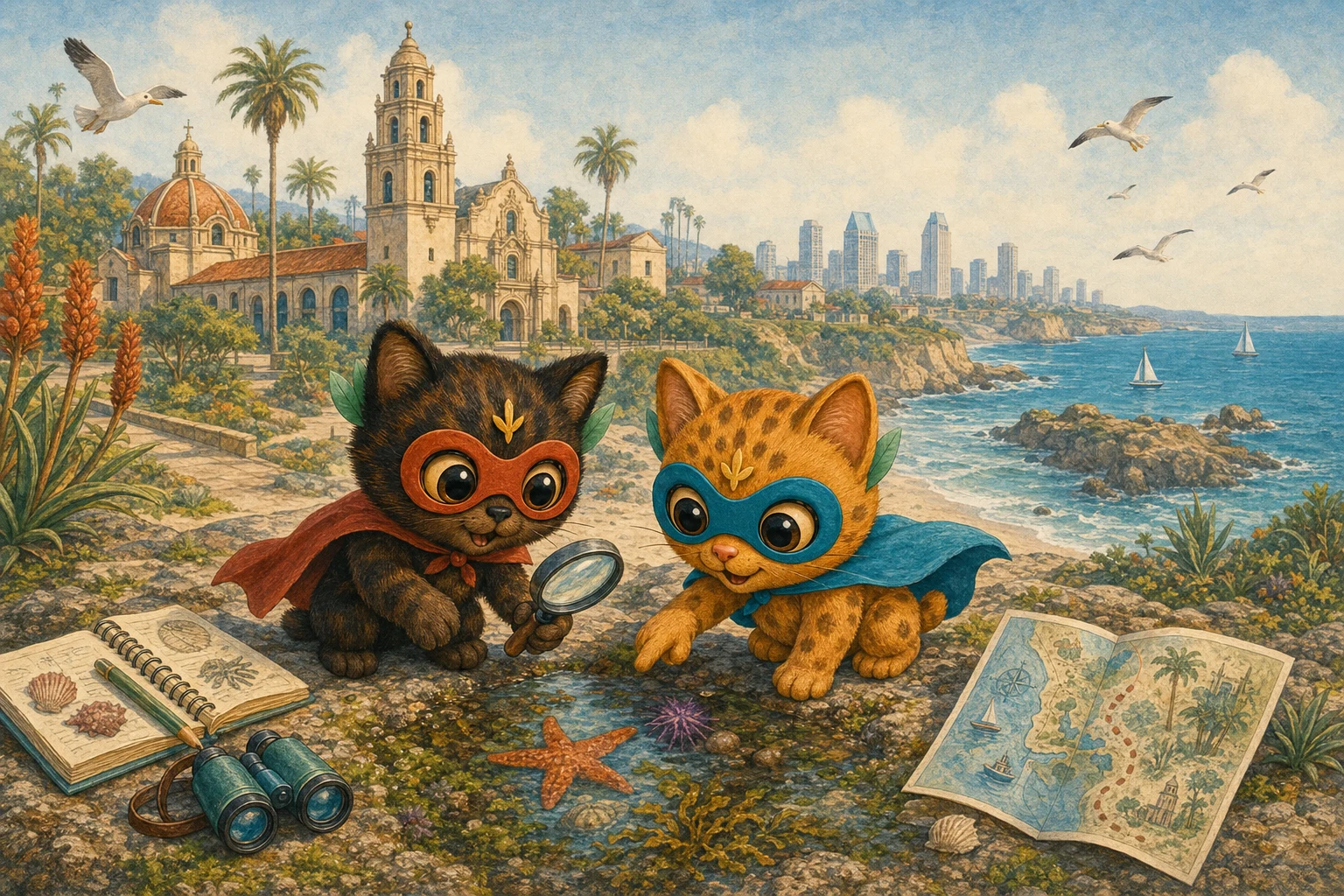
SAN DIEGO WITH KIDS
Things to Do in San Diego with Kids Ages 8–11
Eight San Diego experiences connecting tide pools, ships, wildlife, architecture, beaches, and local history.
Published · 14 minute read
What are the best things to do in San Diego with kids ages 8 to 11?
San Diego is often sold as a list of large attractions, but the most useful family plan connects those attractions to the landscape. Tides explain the shore, canyons shape the parks, ships explain the harbor, and dry climate changes what grows.
- 1. Balboa Park: Read Balboa Park as a city within the city
- 2. San Diego Zoo: Build the zoo visit around habitats
- 3. USS Midway Museum: Investigate how a floating city works
- 4. La Jolla shore: Let the tide decide the lesson
- 5. Cabrillo National Monument: See why Point Loma controls the harbor view
- 6. Old Town San Diego: Ask whose version of early San Diego you are seeing
- 7. Coronado Beach: Compare the resort coast with the working bay
- 8. Birch Aquarium: Connect aquarium tanks to the Pacific outside
Distances across the county are real. Keep each day in one zone and check marine conditions before promising tide pools, swimming, or a particular beach experience.
San Diego family itineraries for one to four days
First San Diego trip
Park, harbor, coast, then history.
Day 1: Balboa Park day
Choose one museum or zoo focus and leave time outdoors. Stops: Balboa Park and San Diego Zoo. The zoo can be the entire day. Drop the second stop if needed.
Day 2: Ship and island coast
Study the working harbor, then cross toward Coronado. Stops: USS Midway Museum and Coronado Beach. Use the ferry when schedules align.
Day 3: Tides and marine science
Let tide time determine the order. Stops: La Jolla shore and Birch Aquarium. Check tides first, then reserve the aquarium around them.
Day 4: Two beginnings of San Diego
Compare the old settlement with the harbor entrance. Stops: Old Town San Diego and Cabrillo National Monument. These areas require a direct drive or transit plan.
Wildlife and coast
Tides and habitats lead the plan.
Day 1: Tides and marine science
Let tide time determine the order. Stops: La Jolla shore and Birch Aquarium. Check tides first, then reserve the aquarium around them.
Day 2: Balboa Park day
Choose one museum or zoo focus and leave time outdoors. Stops: Balboa Park and San Diego Zoo. The zoo can be the entire day. Drop the second stop if needed.
Day 3: Two beginnings of San Diego
Compare the old settlement with the harbor entrance. Stops: Old Town San Diego and Cabrillo National Monument. These areas require a direct drive or transit plan.
Day 4: Ship and island coast
Study the working harbor, then cross toward Coronado. Stops: USS Midway Museum and Coronado Beach. Use the ferry when schedules align.
Stop 1: Balboa Park
Read Balboa Park as a city within the city
The park combines museums, gardens, performance spaces, trails, ornamented buildings, and the zoo. Start by choosing one institution and one outdoor route.
Children can compare architecture, planting, and public uses without entering every building.
Bobo & Lumen mission: Design a symbol for Balboa Park that represents more than the zoo.
Good to know: The park covers more than one thousand acres. Choose one cluster and check museum closing days before arrival.
Stop 2: San Diego Zoo
Build the zoo visit around habitats
Instead of collecting animal names, compare how habitats provide shade, water, climbing, hiding, and social space.
Let children choose one climate zone and follow adaptations across several species. The zoo’s slopes make a route plan especially valuable.
Bobo & Lumen mission: Find three different solutions animals use to manage heat.
Good to know: Expect hills and a long visit. Check daily presentations and use transportation inside the zoo strategically.
Stop 3: USS Midway Museum
Investigate how a floating city works
An aircraft carrier must produce food, power, navigation, communication, medical care, and living space while operating at sea.
Choose one system and follow its evidence through the ship. Aircraft are impressive, but the everyday logistics tell the deeper story.
Bobo & Lumen mission: Find five services the ship needed that your neighborhood also needs.
Good to know: Expect ladders, tight passages, noise, and limited accessibility in some areas. Check current entry and safety information.
Stop 4: La Jolla shore
Let the tide decide the lesson
At low tide, children can look for zones where different organisms survive. At higher water, the same rocks tell a story about waves, erosion, and exposure.
Observe from a respectful distance and compare seals or sea lions without approaching, feeding, or blocking their route.
Bobo & Lumen mission: Find three clues showing how high the water reaches when the tide returns.
Good to know: Check tide tables and marine warnings. Rocks can be slippery, and wildlife boundaries must be respected.
Stop 5: Cabrillo National Monument
See why Point Loma controls the harbor view
From the peninsula, children can read the entrance to San Diego Bay, military geography, lighthouse placement, and the Pacific coastline.
The historic lighthouse and coastal trail answer different questions. Choose according to weather, tide, and mobility.
Bobo & Lumen mission: Select the best location for a lighthouse and explain your choice using the coastline.
Good to know: Tide pools require low tide and safe conditions. Parking fills on busy days, and coastal weather can differ from downtown.
Stop 6: Old Town San Diego
Ask whose version of early San Diego you are seeing
Buildings, demonstrations, shops, and exhibits present parts of Mexican and early American San Diego. Children should ask what is original, reconstructed, interpreted, or commercial.
Compare signs and objects across several sites before deciding what the district communicates best.
Bobo & Lumen mission: Find one object that teaches history and one that is mainly designed to be sold.
Good to know: Programs and building hours vary. Use official interpretation first and discuss how public history chooses what to emphasize.
Stop 7: Coronado Beach
Compare the resort coast with the working bay
Crossing to Coronado reveals beaches, naval activity, ferries, hotels, and downtown from a new angle.
Children can compare the ocean-facing shore with the calmer bay side and identify how people use each waterfront differently.
Bobo & Lumen mission: Create two safety signs, one for the ocean side and one for the bay side.
Good to know: Check water quality, surf, and flag warnings. Beach conditions and safe swimming areas change.
Stop 8: Birch Aquarium
Connect aquarium tanks to the Pacific outside
Focus on local kelp forests, tide pools, seahorses, or climate research, then look through the windows toward the ocean those systems belong to.
Ask what an aquarium can show clearly and what can only be understood in the wild.
Bobo & Lumen mission: Choose one tank and design the field observation that should come next.
Good to know: Reserve when required and combine the aquarium with La Jolla only if tides and traffic make the sequence sensible.
Practical planning tips for families
- Use tide tables as a planning tool, not an afterthought.
- Keep each day in one geographic zone.
- Carry water, sun protection, and an extra layer near the coast.
- Choose either the zoo or several Balboa Park museums, not both at full length.
- Check beach water and surf conditions before swimming.
Check current details before you go
Opening hours, reservation rules, accessibility, and temporary closures can change. Use these primary sources when planning:
Explore San Diego with the illustrated kids' guide
The guide gives children enough context to understand what they are seeing, then hands them something specific to investigate. It works before the trip, on the street, and again when the family gets home.
See inside the San Diego travel guide for kids