SAN FRANCISCO WITH KIDS
Things to Do in San Francisco with Kids Ages 8–11
Eight San Francisco experiences using hills, cables, fog, bridges, science, islands, and neighborhood detail.
Published · 14 minute read
What are the best things to do in San Francisco with kids ages 8 to 11?
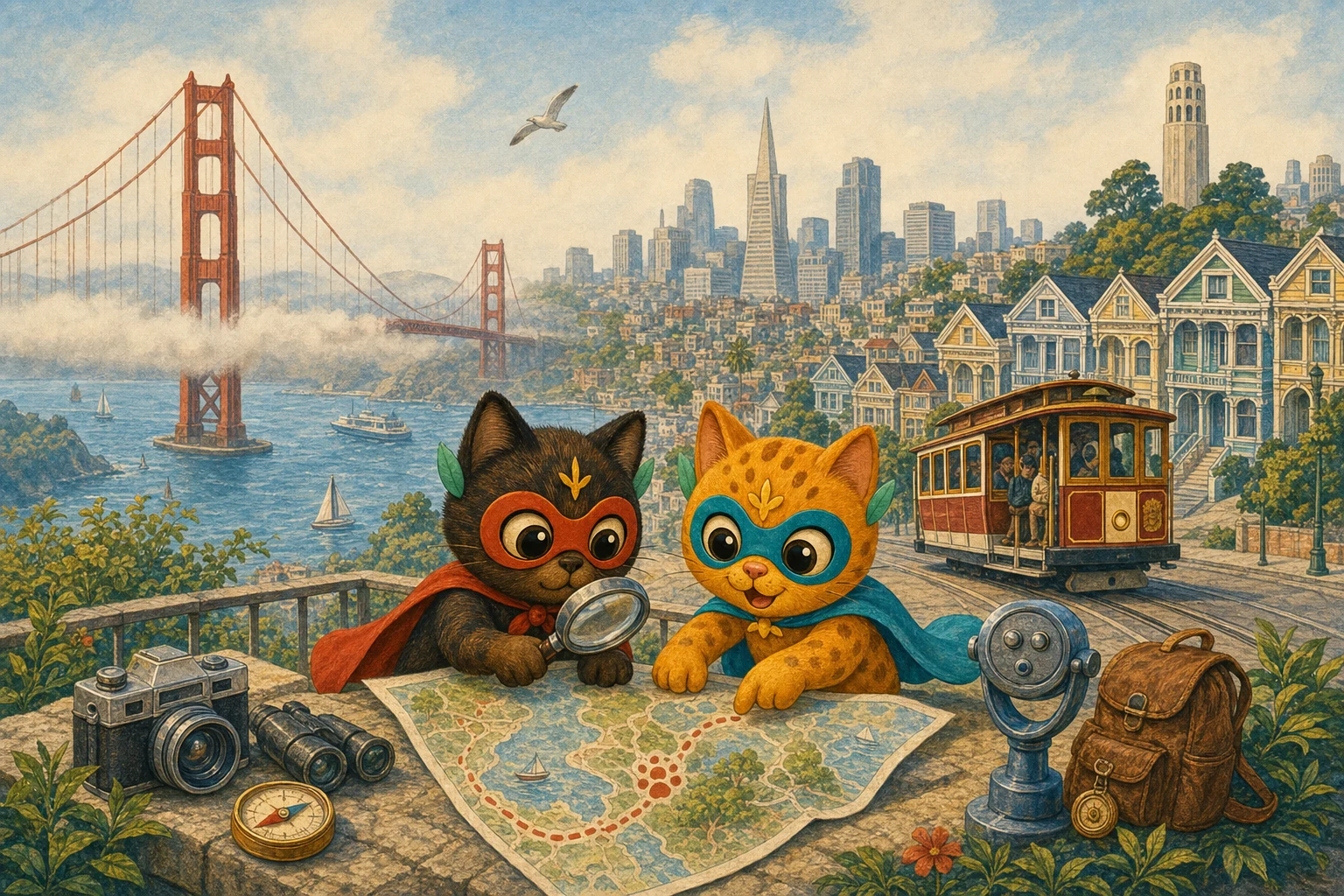
San Francisco gives children visible systems to investigate. Cable cars grip a moving cable, fog pours through gaps in the hills, bridges cross difficult water, and neighborhoods change within a few blocks.
- 1. Cable Car Museum: See the machinery beneath the cable cars
- 2. Presidio and Crissy Field: Study the Golden Gate Bridge from the shore
- 3. Exploratorium: Choose experiments that answer one question
- 4. Alcatraz Island: Separate the island’s stories
- 5. Chinatown: Read a neighborhood through signs and food
- 6. Golden Gate Park: Build a science-and-park day
- 7. Ferry Building and Embarcadero: Use the waterfront to understand the city
- 8. Mission District murals: Let murals tell the neighborhood story
The hills make distance deceptive. Plan by elevation and transit as well as map distance, and keep the warmest layer in the bag even when the morning begins in sunshine.
San Francisco family itineraries for one to four days
First San Francisco trip
Bay, bridge, cable cars, and island first.
Day 1: Bridge and bay
Use the Presidio and Embarcadero to understand the waterfront. Stops: Presidio and Crissy Field and Ferry Building and Embarcadero. Keep the route flexible around fog and wind.
Day 2: Cables and experiments
Investigate two very different kinds of machinery. Stops: Cable Car Museum and Exploratorium. Ride the cable car between questions, not simply for the photo.
Day 3: Alcatraz and Chinatown
Pair one reserved island trip with an open-ended neighborhood walk. Stops: Alcatraz Island and Chinatown. Let the ferry schedule control the first half of the day.
Day 4: Nature and neighborhood art
Use the park for science and the Mission for public storytelling. Stops: Golden Gate Park and Mission District murals. These areas are separated. Use one direct transit connection.
Mostly outdoors
Parks, murals, and waterfront before ticketed stops.
Day 1: Bridge and bay
Use the Presidio and Embarcadero to understand the waterfront. Stops: Presidio and Crissy Field and Ferry Building and Embarcadero. Keep the route flexible around fog and wind.
Day 2: Nature and neighborhood art
Use the park for science and the Mission for public storytelling. Stops: Golden Gate Park and Mission District murals. These areas are separated. Use one direct transit connection.
Day 3: Cables and experiments
Investigate two very different kinds of machinery. Stops: Cable Car Museum and Exploratorium. Ride the cable car between questions, not simply for the photo.
Day 4: Alcatraz and Chinatown
Pair one reserved island trip with an open-ended neighborhood walk. Stops: Alcatraz Island and Chinatown. Let the ferry schedule control the first half of the day.
Stop 1: Cable Car Museum
See the machinery beneath the cable cars
At the museum, children can watch the moving cables that pull cars through the streets. The system becomes much clearer once they see that the car grips and releases a cable below the roadway.
Ride only after investigating the machinery, then listen for the grip and brake as the car climbs.
Bobo & Lumen mission: Explain how a car can stop while the underground cable keeps moving.
Good to know: Queues at terminal stops can be long. Board at a quieter stop when appropriate and keep children seated or securely positioned.
Stop 2: Presidio and Crissy Field
Study the Golden Gate Bridge from the shore
Crissy Field shows the bridge, bay, tides, wind, former military landscape, and moving ships in one view. Children can watch how the bridge disappears and reappears in fog.
Presidio Tunnel Tops adds play spaces and overlooks without requiring another ticket.
Bobo & Lumen mission: Find three reasons this was a difficult place to build a bridge.
Good to know: Wind can make the waterfront much colder than inland neighborhoods. Check fog and trail conditions and bring layers.
Stop 3: Exploratorium
Choose experiments that answer one question
The Exploratorium rewards touching, changing, and repeating. Pick a theme such as light, sound, perception, weather, or motion and compare several exhibits.
The waterfront location makes it easy to test museum ideas outside using waves, reflections, wind, and bridge structures.
Bobo & Lumen mission: Find one experiment where your prediction was wrong and explain what changed your mind.
Good to know: The museum can absorb a full half-day. Check hours and special galleries, then leave the afternoon flexible.
Stop 4: Alcatraz Island
Separate the island’s stories
Alcatraz is not only a prison story. It is also a military site, lighthouse, bird habitat, garden, and place of Indigenous activism.
Ask children to collect evidence for two different histories rather than following only the most dramatic prison details.
Bobo & Lumen mission: Choose the island story that the buildings tell best and the one that requires the most explanation.
Good to know: Use the official ferry, reserve well ahead, and expect steep walking and exposed weather. Bring water and layers.
Stop 5: Chinatown
Read a neighborhood through signs and food
Compare street names, languages, balconies, shops, temples, produce, bakeries, and alley widths. Look for what serves residents and what is designed mainly for visitors.
Choose one food with an unfamiliar name and ask how it is made. The goal is observation and conversation, not collecting snacks.
Bobo & Lumen mission: Find one detail that tells you people live and work here, not only visit.
Good to know: Use daylight hours, stay together on narrow pavements, and ask before photographing people or inside businesses.
Stop 6: Golden Gate Park
Build a science-and-park day
Choose one institution, such as the California Academy of Sciences, then use the park for the rest of the day. Gardens, paths, bison, lakes, and open spaces are not simply gaps between attractions.
Children can compare habitats inside the museum with plants, birds, and weather outside.
Bobo & Lumen mission: Find one living system inside the museum and a related example outside in the park.
Good to know: The park is longer than it looks. Choose one cluster and use transit rather than trying to walk its entire length.
Stop 7: Ferry Building and Embarcadero
Use the waterfront to understand the city
Watch ferries, container ships, bicycles, streetcars, and pedestrians share the edge of the bay. The Ferry Building shows how an old transportation hub can find a new role.
This route works well without a reservation and can expand or contract with energy.
Bobo & Lumen mission: List every different way people and goods move through the waterfront.
Good to know: Market days are lively but crowded. Keep the walking route short and watch bicycle traffic along the promenade.
Stop 8: Mission District murals
Let murals tell the neighborhood story
Choose a compact mural area and look for repeated subjects, languages, colors, political messages, and local history. Children can learn that public art often speaks to people who already live nearby.
Compare a commissioned mural with an informal piece and discuss who controls a wall.
Bobo & Lumen mission: Choose one mural and explain what it wants a passerby to notice or remember.
Good to know: Visit in daylight, stay on a planned route, and treat murals and residents respectfully. Murals change, so expect discoveries beyond any guide.
Practical planning tips for families
- Plan for hills, not only distance.
- Carry layers every day.
- Reserve Alcatraz before building the rest of the itinerary.
- Use Muni to connect neighborhoods instead of moving a car repeatedly.
- Pair one indoor attraction with one outdoor district.
Check current details before you go
Opening hours, reservation rules, accessibility, and temporary closures can change. Use these primary sources when planning:
Explore San Francisco with the illustrated kids' guide
The guide gives children enough context to understand what they are seeing, then hands them something specific to investigate. It works before the trip, on the street, and again when the family gets home.
See inside the San Francisco travel guide for kids